
You can see it, can’t you… Dr. Frankenfurter spitting out that word with that glorious space in the middle.
It’s like that when you age whisky at home. And since I’m aging American Slash Texas Whiskey, it gets an e.
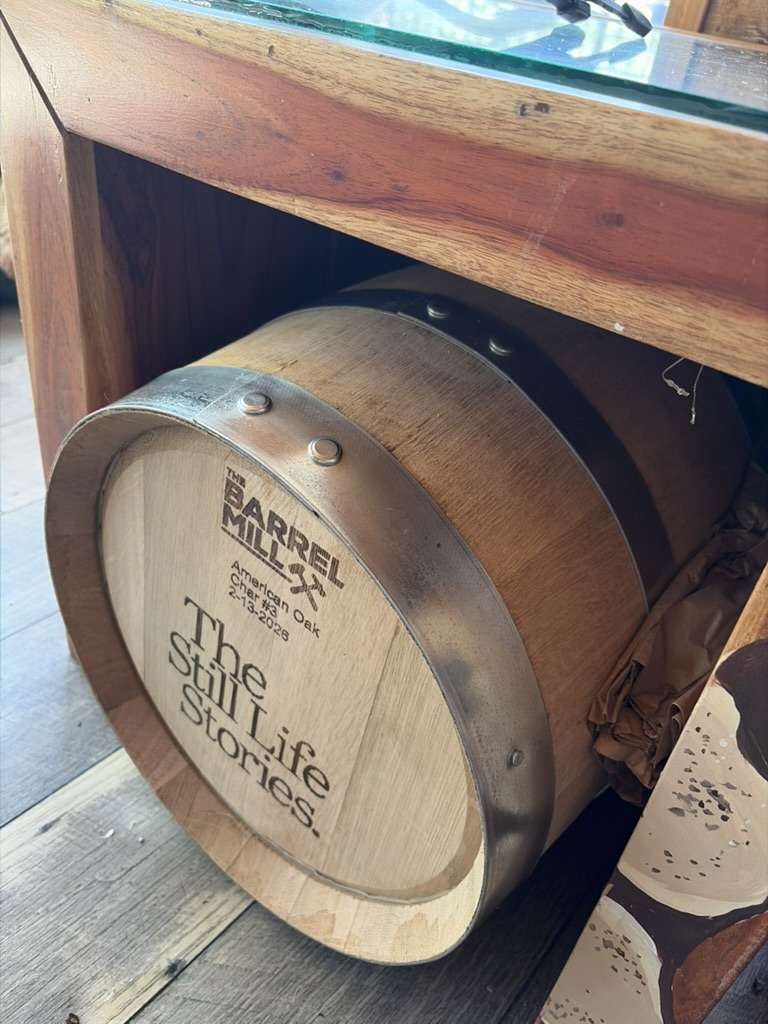
I ended up with five gallons of unaged Fox and Seeker unaged Texas whiskey a while back, and it’s been sitting patiently in its bottles, waiting for oak. A few weeks back, I finally got around to ordering a 5-gallon oak barrel from a company called The Barrel Mill and set out to pair my whisky with its natural environment: a charred oak barrel.
I’ve spent a lot of time around oak casks full of whisky while traveling the world for The Still Life Stories, and there is just something a bit magical about walking into the aging warehouse full of hundreds of sleeping casks full of whisky.
So many caterpillars waiting to become butterflies.
It’s a bit of alchemical magic to see what happens.
And major kudos to whoever it was that invented and made the first oak storage barrels. I’ve seen stories that the ancient Egyptians built wood casks to store liquids.
They really are a miracle of packaging. What other package can allow one person to easily move almost 600 lbs of liquid without machinery? I’ve done it plenty of times. If the cask is sitting on its flat end, rock it a bit, and it’ll roll harmlessly on its side. Then you just roll it wherever you want to go, turning easily around corners. Rock it back and forth and put it back on its end without much effort.
It’s brilliant packaging, and it makes the product better.
Not much packaging can say that.
One issue is shoes. Before I first headed to a distillery in Scotland, I asked them if I needed steel-toed boots to work in the warehouse, and they said yes. Scottish Health and Safety takes this stuff seriously. So a few days before I left, I picked up a pair of carbon fiber-toed electrician’s cowboy boots.
They’re about as Texas as anything could possibly be. They were a hit in Scotland and they go on every Still Life Stories journey now. I imagined a 600 lb cask of whisky rolling over the top of my foot, so I embrace my gaudy cowboy boots.
Now this 5-gallon oak cask is a different story.
It’s pretty easy to pick up and move around.
So the folks at The Barrel Mill make a great product. I saw a lot of leaking casks in bond stores/warehouses/rickhouses all over the planet. When you bundle a bunch of oak sticks together with steel hoops, you can easily imagine how water could find its way out. So there were always dark whisky stains on the floor from escaping whisky.
I was prepared for this. The process is to fill the cask with warm water and let the oak soak it in and expand for a day or so before you fill it with precious whiskey.
I did that. Put it in the kitchen sink and fill it with warm water.
It sat overnight, happily absorbing that water, and the next day, nary a leaked drop. Empty out the water and start opening bottles. Around two cases of beautiful Fox and Seeker unaged whiskey bottles got opened and poured into the cask. A good long sniff while the bung was still open.
That delightful scent is ever carved into my memory. A warehouse full of sleeping whiskey barrels. Whisky and oak doing that eternal, slow-motion waltz.
I used a rubber mallet to hammer the oak bung back in place and put the new baby under a side table.
The cask surface it quite beautiful. It’s oak. And the steel bands that hold this jigsaw puzzle together are galvanized so they won’t rust.
I saw a lot of rusty steel all over the world.
There are no gaps or faults or leaks. It’s a first-rate piece of equipment. I’ve been to cooperages in Scotland and watched these iron-armed guys knock off the hoops and tear a barrel down and rebuild it in minutes. Hand carving the oak, fitting and refitting. Taking hundred-year-old casks apart, sanding down the inside, rebuilding and recharring and renewing, ready for another dozen years of holding whisky. It’s a fascinating process, and it’s surprising that you can build a waterproof container out of a tree, and then roll it around with 600 lbs of water inside and not spill a drop.
And now that this little miracle is snoozing away in the corner of the room, I hear it talking go me. “Psst.. Wanna see what one week is like?”
I imagine whiskey makers all over the world wonder the same thing. Do everything right, use great barley, great water, make the mash, distill in fancy equipment at exactly the right heat and time, and then decant it and put it into oak…
And wait.
Maybe for a decade or more.
Of course, most distillers will sample that whisky at regular intervals to see how it’s progressing. And they might move it to a different cask at some point, a sherry cask to give it a little red sherry color and flavor. Every distiller has their own pathway for the oak. The really big McWhisky distilleries might just put it in oak and walk away for four years and a day, then put it in bottles, but all the independent distilleries I’ve spent time with babysit and guide every drop along its path.
Doing it at home is a bit similar to wondering how your kids will be as adults. Will they grow up to be decent human beings or ax murderers? Not that any whiskey will turn out that bad. Especially when it starts out well. I tasted this whiskey before it went into the oak, and it was fantastic. At 112 proof and totally unaged, one would assume some sharp edges, but that’s not the case here. This spirit is elegant, a little sweet, and with a nice finish.
Now every day I wonder how it’s getting along with its new environment.
I asked a lot of distillers if they have a favorite cask, and most do. Paul Shand at Tria Prima in the hills above Adelaide, Australia, has a favorite cask. It’s an old American bourbon cask he calls Tiramisu, after the Italian dessert.
I tasted that whisky, and yes, it had tiramisu all over the place. Imagine that. A whisky that makes you think of an Italian dessert.
I don’t know the character of this cask yet, but whisky will age pretty quickly in a 5-gallon cask.
So I’ll be doing a monthly tasting with friends.
Tough duty. Volunteers accepted. I kept the bottles so I can bottle some up as gifts when it’s hit a peak.
I suggest you buy a 5-gallon cask from www.TheBarrelMill.com and start growing some fine whisky at home. It’ll be good for your imagination, and it’ll bring good juju to your house!
