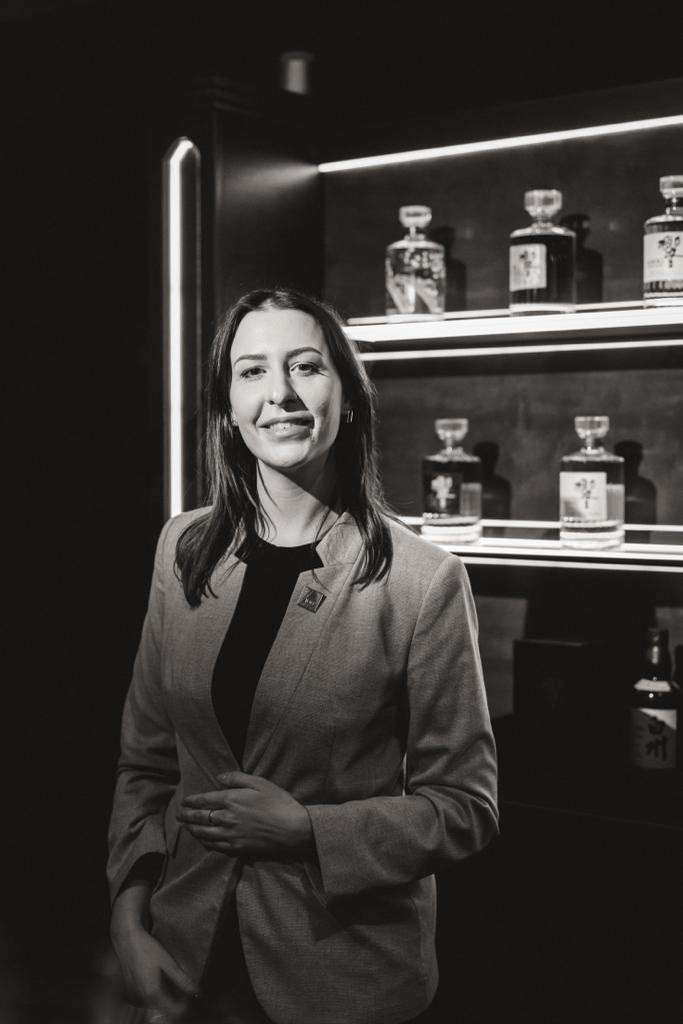
Pauline Scholz spent much of her life in Austria, where she represented Japanese whisky. Now she’s living in Tokyo, creating customer experiences at The Bar High Five.
1. Do you remember the whisky that turned drinking whisky into wanting to understand whisky?
Absolutely. It was Laphroaig.
I discovered it when I was 18, which is the legal drinking age in Austria, and I remember being completely fascinated by its smell. It was unlike anything I had experienced before — smoky, intense, almost medicinal.
At the time, I didn’t understand why it smelled that way. Later, when I started learning more about whisky, I discovered that those distinctive smoky aromas come largely from peat.
And I became very nerdy about it, very quickly. I wanted to understand everything about Laphroaig — where those aromas came from, how it was produced, the influence of Islay, the peat, the maturation and the history behind the distillery.
I even started collecting Laphroaig when I was 18. Now, almost 30, I have built quite a large collection over the years, which makes it even more special to me.
Laphroaig was the first whisky that made me curious enough to look beyond what was simply in my glass. It was the whisky that awakened my love for whisky — and all these years later, that connection is still there.
2. When someone tells you, “I don’t know anything about whisky,” where do you start?
I actually think that’s a wonderful place to start.
I would begin with the very basics: What actually is whisky? What is it made from? I would explain the role of grain, water, fermentation, distillation and maturation, and give them a little introduction to the history of whisky and how it developed over time.
From there, I would introduce them to what I like to call the five major whisky nations: Scotland, Ireland, Canada, the United States and Japan.
Rather than only explaining the differences theoretically, I would put a whisky from each country in front of them. That way, they can taste for themselves how different traditions, grains, production methods, climates and philosophies can create completely different styles of whisky.
But most importantly, I would tell them the stories behind those whiskies.
When you learn about the people who made a whisky, the land it comes from, its history, traditions and the decisions that went into creating it, you start to appreciate what’s in your glass on a completely different level.
For me, whisky becomes much more interesting when you understand its story. You’re not just drinking a spirit anymore — you’re discovering a place, the people behind it, and sometimes generations of knowledge and tradition.
The more you understand whisky, the more you can appreciate it — but you never need to know everything to enjoy it.
3. What’s something people are taught about whisky that you think we should probably stop teaching them?
One of the biggest misconceptions I would love to change is that whisky is an “old man’s drink.”
Whisky is for everyone to enjoy. Over the years, I’ve met so many younger people who were genuinely fascinated by whisky but almost felt like they were “too young” to drink it or that they didn’t belong in the whisky world.
And I always wondered: why should there be an age for appreciating whisky?
Of course, you have to be of legal drinking age, but beyond that, whisky shouldn’t belong to a particular generation, gender or type of person. If you’re curious about it, there should be a place for you at the table.
I also think we should stop teaching people that there is only one “correct” way to drink whisky. A classic example is being told that you should never add water.
I completely disagree.
Water can be an incredible tool. It can open up different aromas and flavours and bring a whisky to a drinking strength that you personally enjoy.
I like to explain it with an image. Imagine standing in a field, in one particular spot in the grass. You go home and it starts to rain. When the rain stops, you return to exactly the same spot and take a deep breath.
Suddenly, you can smell the wet earth, the grass and the flowers much more intensely. It’s exactly the same place, but you’re experiencing it differently.
That’s how I see adding water to whisky. You’re not taking something away from it. Sometimes you’re simply allowing yourself to discover something that was already there.
Whisky should be about curiosity and enjoyment, not intimidation or unnecessary rules.
4. How did you end up involved in the Japanese whisky industry?
I actually ended up in the whisky industry through my curiosity about spirits.
I was working as a bartender and wanted to deepen my knowledge, so I started studying spirits more seriously while preparing for the Bar Masters in Munich. It’s a qualification where you learn extensively about different spirits, their history, distillation, production and cocktails. That really opened my eyes to how much there is to discover behind every bottle.
At the same time, I was working as a bartender in Vienna, and I won my first award. That gave me even more confidence to keep pushing myself and learning.
Later, I was discovered by Suntory, who were impressed by my whisky knowledge and passion. But I think I also suited the role because of my international background and my understanding of luxury and craftsmanship.
I grew up internationally and spent much of my childhood in Asia, so I developed a deep appreciation for the dedication, patience and attention to detail that goes into Japanese craftsmanship. Those values really connected with what Suntory represents as a luxury whisky house.
I joined them as one of their youngest Brand Ambassadors, which was an incredible opportunity for me. From there, I continued developing my skills, and I eventually made it into the Top 10 at the Mixology Awards for Austria, Germany and Switzerland.
For me, getting into Japanese whisky was really a combination of curiosity, hard work, my international background, and being lucky enough to have people recognize that passion and see that I was a natural fit for the brand.
5. Can someone actually be taught to have a better palate, or are some people simply born with one?
I absolutely think you can train your palate, but I also believe every palate is different.
Our sense of smell is strongly connected to memories and experiences. The more things you consciously smell and taste, the more associations you build, and the easier it becomes to recognize and describe aromas.
When I was a young bartender, I used to buy aroma kits to train my sense of smell. They contained many different aromas you might encounter in whisky, and I spent a lot of time smelling them, trying to identify them and creating memories around them.
But even after all that training, I might still find something completely different in a whisky than the person sitting next to me — and I think that’s beautiful.
In Japan, whisky blenders take sensory consistency extremely seriously. Their routines and even aspects of their diet can be carefully controlled so that their palate remains as consistent as possible when evaluating whisky and maintaining the quality of a blend.
So yes, I believe you can absolutely train your senses. But developing a better palate doesn’t mean learning to taste what somebody else tells you to taste. It means becoming better at recognizing, remembering and expressing what you experience.
6. What’s a whisky you’ve poured for someone that completely changed what they thought they liked?
Hibiki Japanese Harmony.
I was working at the Vienna Whisky Fair when a gentleman came up to me and explained that he didn’t actually like whisky at all. He had only come along because his friend wanted to visit. To him, whisky was simply too powerful and too strong.
I poured him Hibiki Japanese Harmony over an ice ball, and he was genuinely surprised. Suddenly, he discovered that whisky could be subtle, refined and complex at the same time. He also loved the idea of the ice ball and how the drink slowly evolved as it melted.
I then introduced him to Japanese whisky drinking culture, including Mizuwari, and he became fascinated by the different ways whisky could be enjoyed.
The most beautiful part of the story is that we’re still in contact today. Every now and then, he sends me a picture of a new Japanese whisky he has added to his collection.
For me, that’s one of the most rewarding parts of what I do. It’s not about convincing somebody to like whisky. Sometimes it’s simply about finding the right whisky, and the right way of serving it, for that particular person.
7. What’s the hardest part about being foreign in Japan?
I think the hardest part about living in Japan is realizing how much I have to learn again.
It’s a completely different culture, with different customs, manners and ways of communicating. Things that might feel completely natural to me can be understood differently here, so I’ve had to learn to observe more, listen more and adapt.
But I actually find that process incredibly interesting, because every day teaches me something new.
After living here for six months, I also have to admit that I sometimes really miss speaking my own language. I don’t have anyone here to speak German with, and naturally, there are moments when it’s simply easier to express certain thoughts or emotions in your native language.
But I’m taking that as part of my journey as well. I want to learn how to express myself just as naturally and confidently in English.
At the same time, I truly love Japan. I’m fascinated by the dedication to even the smallest details, especially when it comes to craftsmanship, hospitality and spirits.
And despite the language barrier, I don’t feel lonely. I’ve always been good at communicating across cultures, and I truly believe that sometimes a glass of whisky is enough to make friends at a bar. You might not speak the same language, but you can still share an experience.
For me, every day here is an adventure. I’m constantly learning — about Japan, about other people and also about myself.
8. What’s something you’ve changed your mind about after years of studying and tasting whisky?
I used to think I always needed to have the right answer.
Especially when I was younger and entering the whisky industry as a young woman, I felt that I constantly had to prove my knowledge in order to be heard and respected.
I thought I needed to know everything about every brand, every production method and every detail. And when tasting, I sometimes worried about saying something “wrong.”
After years of studying, tasting and working as a Brand Ambassador, I’ve completely changed my mind about that.
Everyone experiences whisky differently. We all have different palates, memories and associations with aromas. I might find something completely different in a glass from the person next to me, and today I think that’s one of the most beautiful things about whisky.
There isn’t only one correct way to describe what you taste.
Knowledge is incredibly important, but whisky is also about curiosity, personal experience and conversation. You have to step outside your comfort zone, trust your senses and express what you experience.
Today, instead of wanting to tell someone what they should taste, I’m much more interested in asking them what they discover in the glass.
It took me a long journey to learn that there doesn’t always have to be a right or wrong answer — and that our differences are actually part of the beauty of spirits.
9. If you could teach someone only one thing about enjoying whisky—and then they never read another whisky book or attended another tasting—what would you teach them?
I would teach them how to make the perfect Japanese Whisky Highball.
It might look like simply whisky and soda, but there is so much technique behind making one that is truly refreshing and perfectly balanced.
For me, it starts with an ice-cold glass, chilled whisky, beautiful clear ice and strongly carbonated soda. Everything should stay as cold as possible, and you want to preserve as much carbonation as you can. I personally like to finish mine with a grapefruit twist.
What I love about the Highball is that it represents so much of the philosophy I admire in Japanese whisky culture: simplicity, balance and incredible attention to detail.
Shinjiro Torii, the founder of Suntory, had a vision to create a whisky that was not only made in Japan, but made for Japanese people. He wanted Japanese whisky to develop its own identity rather than simply becoming a copy of Scotch, American, Canadian or Irish whisky.
The idea was to create something suited to the Japanese palate — softer and more refined, while still being incredibly complex.
And I think the Highball beautifully reflects that philosophy.
Japan took something seemingly simple — whisky, soda and ice — and made every detail matter: the temperature of the glass, the quality of the ice, the carbonation, the way you pour the soda and even how much you stir it.
Suntory also played an important role in establishing Highball culture through its Torys Bars in the 1950s, making whisky more approachable and something that could be enjoyed casually alongside food.
Decades later, after whisky consumption in Japan had declined, Suntory helped revive Highball culture again around 2008, particularly with Kakubin, introducing whisky to a new generation as something refreshing, approachable and food-friendly.
So if I could teach someone only one thing, it would be that simplicity doesn’t mean a lack of craftsmanship.
A Japanese Highball may look like just whisky and soda, but when it’s made properly, there is an entire philosophy of balance, precision and enjoyment inside that glass.
10. Last call. No teaching, no tasting notes, no scoring, no analyzing. What are you drinking?
Cocowari.
Chita Single Grain Whisky with coconut water.
Simple, refreshing, unexpected — and something I genuinely love to drink.
No analyzing required.